As a high school teacher, I have spent the last 5 years watching middle schoolers enter high school and being a part of this new journey for them. This milestone marks an important step in students development as they prepare to enter a more independent environment. Yet, the transition to high school isn’t the most important. The transition to middle school is.
There’s a moment in every student’s academic life — usually somewhere around fifth or sixth grade — when the demand quietly changes. Up to that point, school teaches students how to read. After that, school expects students to read to learn. At the secondary level, in middle and high school, a majority of information is presented to students in written format, even in STEM classes, making reading the single most important skill that students need to develop before middle school – and the data shows that more and more, students are not meeting that standard. The 2024 “National Report Card”, the NAEP report, revealed that only one third of students nationwide are reading at a proficient level in the fourth grade.
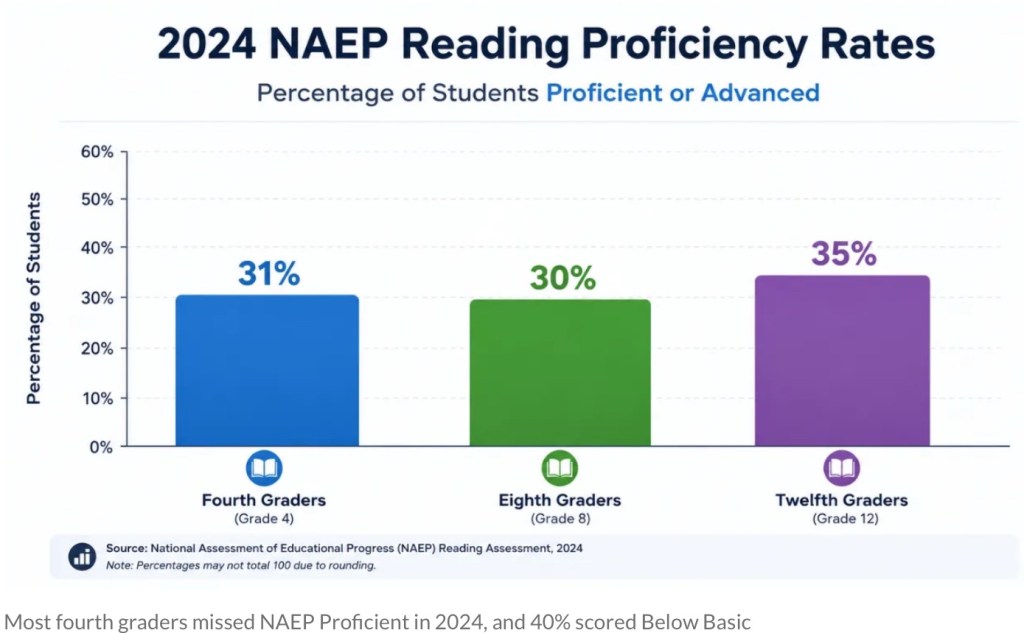
For students who are not reading at grade level, secondary education becomes much less accessible. And in STEM classrooms, it arrives hardest. Science and technical texts are among the hardest students will encounter in secondary school. Multi-clause sentences, definitions embedded mid-paragraph, heavy passive voice, nominalizations, and diagrams that carry information the prose assumes you already absorbed — all of it competing for the same limited working memory.
A student who reads a short passage in English class with ease can stall completely on a paragraph about cellular respiration. That’s not a character flaw or a motivation problem. It’s a text-complexity problem, and it’s solvable.
The good news: STEM teachers don’t need a reading certification to move the needle. In this blog post we will share three small, structural changes to how you assign, present, and discuss text will change how you approach instruction, not just for your struggling students, but for every learner in your room. And, you can stick around for more weekly strategies!
We don’t just talk about it either, we help you do it! By the end of this blog, you will have learned 3 strategies, how and when to implement them, how to plan for them in less than 10 minutes, and examples of what these strategies can look like.
Note: this post deliberately skips vocabulary instruction. Vocabulary in STEM is big enough to deserve its own post, which is coming next week!
Teacher Needs (No Reading Specialist Required)
Strategy 1: Choral and Guided Oral Reading — With Strong Rules
Guided oral reading has one of the more consistent evidence bases in reading research. The National Reading Panel (NICHD, 2000) found that guided repeated oral reading procedures — where students read aloud with support and feedback — produced meaningful gains in word recognition, fluency, and comprehension. When the whole class reads aloud together, or when teachers have students read aloud for the class, we can make any moment into a mini-reading lesson to help exercise that skill for students.
The mechanism matters for understanding why this works in a science and math class specifically. Reading aloud while following along engages decoding, phonological processing, and meaning-making at the same time – in other words, it helps students to build their working memory of the words they are reading, both what the word is (in writing and sound) and what the word means. Combining whole class or choral readings, small group readings, or popcorn readings pushes students to practice their reading fluency, and helps build access to understanding for struggling readers.
In addition to helping students develop fluency, it also works as a strong engagement strategy. Earlier this year, I wrote a piece for Edutopia where I discuss increased opportunities to respond as an engagement strategy, and these reading strategies are a great way to build opportunities to response.
There is one big rule when implementing this strategy – researchers argue that students only engage honestly with feedback when the classroom is safe enough for them to reveal what they don’t know. Hattie’s synthesis in Visible Learning points the same direction — classroom climate and peer relationships shape whether this instructional move lands or bounces.
Translated to a ninth-grade chemistry room: a struggling reader who gets laughed at once will never volunteer again. The strategy doesn’t fail because the research is wrong. It fails because the culture wasn’t built first. Round-robin reading earned its bad reputation honestly — it was implemented without rules, and it humiliated people.
How and When to Use It
When to use it: All the time! Instead of having just one “strong reader” read the directions, do a choral read, or a pop-corn read with some of your struggling readers in the line-up. You can also use this for parts of lecture or 1-3 paragraph readings – this may be difficult to implement for longer readings because it can be a bit more time consuming than independent reading. (We have more strategies below for longer texts!)
When to skip it: Extended text, material students have already mastered, or any day when you haven’t set the norms yet.
The core moves:
- Set norms, repeat them daily, and hold students accountable to them. Set clear discourse norms that students can agree upon paired with their respective consequence if not followed (extra points if you collaborate in creating these norms as a class). Students follow norms they understand, and norms they see you upholding consistently.
- Choose readers deliberately, never in seating order. Sequence lets students count ahead to their sentence, rehearse it in a panic, and absorb nothing else. Plan strategically to integrate your struggling readers intentionally.
- Use choral reading — the whole class in unison — for the hardest passages. Unison gives cover. Nobody is exposed, everyone practices, and shaky readers lean on the voices around them. Lead with this version while trust is still being built.
- Don’t give the answer, teach the skill. When a student stumbles, give them 2-3 seconds, tell them “sound it out”, and if they can’t, you model it. Split the word into syllables, sound out each syllable, and ask the student to put it together.
- Be persistent – new routines take time. The first time you try this strategy will probably be a bit chaotic. And the second time. Maybe the third. The more you practice the routine and the norms, the more natural this practice will become for you and your students to implement daily.
The Hard Part Is the Script, Not the Strategy
Most teachers who abandon oral reading do it after one bad day — a student stumbles, someone snickers, the room goes tense, and the whole thing feels cruel. What separates a classroom where this works from one where it doesn’t is having language ready before the moment arrives.
The resource packet includes a full script: the launch language for the first day, exact wording for when a student laughs, what to say when someone declines to read, and a quick decoding guide to help your students sounding out words. It’s written to be adapted to your voice, not read verbatim — but having something ready beats improvising while thirty students watch.
→ Download the resource packet for the complete choral reading script and launch protocol.
Strategy 2: Modify the Text and Pair It With Visualization
The Research Behind Text Modification
Cognitive load theory explains the core problem plainly. Working memory is finite. A student who is spending most of it decoding has almost nothing left for comprehension, let alone for the conceptual reasoning your lesson actually requires. Reduce the decoding cost and you free capacity for the thinking you care about.
Visualization adds a second channel. Paivio’s dual coding theory holds that information encoded both verbally and visually is more durable and more retrievable than information encoded one way only. STEM content is unusually well-suited to this, because so much of it describes structures, sequences, and transformations — things that can be drawn. Asking a student to sketch a geometry word problem as they read it can help them visualize the text and allow them to engage more meaningfully.
Last week, we discussed tones of strategies about how you can modify texts to support struggling readers, and these apply to your STEM classrooms! Here is what these supports can look like in your classroom:
How and When to Modify a Passage
When to use it: Independent or small group reading work – texts that you are not reading all together as a class chorally or popcorn style. For shorter passages and word problems, rely on emphasizing specific parts of the text as it appears. For longer passages, that is where you can modify the length or reading level of the problem.
The core moves:
- Mark the words that bring out the most meaning. Prioritize technical terms central to the concept and Tier 2 academic words that quietly change meaning — convert, yield, initiate, utilize, undergo, relative to. Those general-academic words trip students more often than the technical vocabulary does, because students know they’re supposed to look up chloroplast and don’t know they should have looked up initiate.
- Add context in place, not in a footnote. A short synonym or brief explanation immediately after the word keeps the student inside the sentence. Sending them to a glossary at the bottom of the page breaks the thread of meaning they’re working to hold. Keep glosses to three words or fewer. A long definition is just a second reading task.
- When modifying longer passages for length or reading level, keep the important vocabulary. Providing shorter readings or readings at the student’s reading level can help students gain access, but if they are not practicing the same key terms as their peers, they will struggle to make sense of the content. Keep key terms with explanations or synonyms.
- When appropriate, use visualization. Have students draw out the geometry word problem, have students make sense of a food chain with a diagram. Make sure you are pushing students to create these images and not entirely replacing reading with diagrams.
- Release the marking over time. Fully marked passage, then partially marked with students finding two more words themselves, then unmarked with a highlighter for students to mark their own text.
For Longer Texts – Same Content, Two Entry Points
The version of this that works best in a mixed-ability classroom working with longer STEM texts is running two Lexile levels of the same passage simultaneously. Students get text they can actually access, but because the underlying content is identical, whole-class discussion still works. You’re differentiating the access, not the conversation — which means no student is visibly excluded from what the room is talking about.
The packet includes a photosynthesis passage built both ways: one at roughly grade level for secondary science text, one substantially below, each with words marked, glosses in place, and a visualization prompt attached. Print them side by side and hand out whichever fits. They’re also a template — once you’ve seen the pattern twice, building your own for the next unit takes about ten minutes.
→ Download the resource packet for both passages plus teacher notes on running them together.
Strategy 3: Annotated Close Reading With Embedded CFU Questions
The Research Behind Text-Dependent Questions
Text-dependent questions cannot be answered without going back into the passage. That constraint is the whole value. Struggling readers are often skilled at avoiding reading entirely — they answer from prior knowledge, from the diagram, from what a classmate said, from a plausible guess about how science usually works. Sometimes they’re even right, which conceals the problem. A well-built text-dependent question closes those exits.
Fisher and Frey’s work on close reading in the disciplines makes the case that this kind of questioning belongs in content classrooms, not just English ones. Shanahan and Shanahan’s research on disciplinary literacy goes further: reading a science text is a genuinely different skill than reading a novel or a historical document, with its own conventions and demands, and it has to be taught by someone who knows the discipline. That someone is you.
How and When to Build One
When to use it: Passages where understanding every sentence matters — conceptual explanations, causal chains, anything students will need to reason from later. This is your slowest strategy. Use it on the paragraph the whole unit depends on.
The core moves:
- Chunk at conceptual seams, not by word count. Break where one idea finishes and the next begins — typically two to four sentences.
- Put the questions in the right margin, beside the text they refer to. Proximity matters. A question at the end of the page asks students to remember; a question beside the paragraph asks them to reread, which is what you want.
- Keep questions concrete and answerable from the text. “What does the text say happens to the glucose?” not “Why do you think cells need energy?” Save the interpretive questions for discussion after the reading is secure.
- Require annotation, not just answers. Students underline the sentence containing the answer before they write anything. This makes the location of meaning visible and gives you something to point at when a student is off track.
- Check in after every chunk, not at the end. Two or three students share, you correct misconceptions on the spot, everyone moves on together. Formative assessment you can act on inside the same period.
- Stack Strategy 2 inside this one. Gloss the dense sentences using the same in-place approach. The two strategies reinforce each other.
Why the Question Placement Matters More Than the Questions
The most common way this strategy gets watered down is teachers writing good questions and then putting all of them at the end. That single choice converts a rereading task into a memory task, and struggling readers fail memory tasks on dense text almost every time. Margin placement is not a formatting preference — it’s the mechanism.
The packet includes a complete four-paragraph cellular respiration reading with CFU questions positioned after each chunk, glossed vocabulary built in, a simplified alternate paragraph for students reading well below grade level, and teacher notes on releasing it one paragraph at a time rather than all at once.
→ Download the resource packet for the full annotated biology reading.
From Learning to Read to Reading to Learn
These strategies aren’t really about photosynthesis or cellular respiration. They’re about the habits students build while working through those passages.
Choral reading with real norms teaches students that reading aloud is a tool for understanding rather than a test of performance. Text modification teaches them that hitting an unfamiliar word is normal and survivable, and that there are moves available when it happens. Annotated close reading teaches them to slow down, go back, and locate meaning in specific sentences instead of guessing at the gist.
None of this replaces intensive intervention for students with significant reading disabilities. Those students need specialized, systematic instruction from someone trained to deliver it, and a science teacher marking up a passage is not a substitute for that. Be honest with yourself about which of your students are in which category.
But for the substantial group in the middle — students who can decode adequately and still drown in technical text — these three moves change what’s possible in your classroom. They are small. They are cheap. They compound.
Start With One
Pick a single strategy and use it this week. Notice what happens — which students engage who normally don’t, where it breaks down, what you’d change. Then add the second. The teachers who successfully build this into their practice almost never start with all three.
Two related pieces worth reading alongside this one. First, if you’re using audiobooks or text-to-speech with your students, the question of when and how to release them from those supports is the other half of this conversation — every accommodation needs a gradual release plan built in from the start, or it produces dependence instead of growth. Second, a dedicated post on vocabulary instruction in STEM is coming, because it’s too large to fold into a list like this one.
Your students are still learning to read. They’re also being asked to read to learn. Both of those are your job now, whether or not that’s what you signed up for. The good news is that the moves are small.


Leave a Reply