Every secondary teacher has done this. A student can’t access the novel, the article, or the primary source document. You have twenty-eight other kids, a bell schedule, and a lesson that assumes everyone reads at grade level. So you hand the student a pair of headphones and pull up the audio.
I’ve done it. Audio can be a powerful accessibility tool in the classroom, but it can also become a new barrier.
When I started teaching five years ago in a self-contained special education classroom, we had a set of headphones in every room. At the secondary level, explicit reading instruction was limited if at all existent so headphones provide the access students need to engage with their courses. I watched students who had spent years locked out of grade-level content due to reading deficiencies finally follow a plot, analyze a text and join a discussion. That part was real, and an important and valid way of building access in the classroom.
But at the end of that first year I noticed something that has stayed with me. My students could access more, but not one of them was reading any better than in September — and several had stopped even trying to read on their own, because the headphones were always right there. We had handed them a support and never talked about taking it back.
This post isn’t an argument against audiobooks or text to speech accommodations – again, those are real supports proven to work!
However, like with any other support we provide through the IEP, we ALSO want to think about a gradual release plan, or a plan to measure student growth and slowly, overtime, remove some of or part of the supports, such as audio support for reading. A support that comes with no fade plan stops being a bridge to somewhere and quietly becomes a place the student lives. While audio solves the immediate challenge – a student who can’t read at grade level but needs to access the text – it fails to address the underlying problem – a student who can’t read at grade level.
Through the strategies below, you can continue to provide audio accommodations for your students whose IEPs call for them but with a renewed purpose and direction. Now, you have the knowledge and resources to craft a plan to push the reading abilities of your adolescent learners and slowly reduce their reliance on this support.
The three tools below aren’t just alternatives to audio — they’re a sequence, each one asking a little more of the reader than the last, so that the support you give in September isn’t the same support they still lean on in May.
Audiobooks Are Not the Enemy
Let’s separate two things that get collapsed constantly in IEP meetings.
Access means the student can get to the content. Instruction means the student is getting better at something.
Audio is an access tool. It is a genuinely good one, and the research supports it. A meta-analysis by Wood, Moxley, Tighe, and Wagner pulled together 22 studies with 2,942 participants and found that text-to-speech and read-aloud tools were effective in improving reading comprehension for students with reading disabilities. That is a real, meaningful effect. Audio works.
When audio is the right call
- The student’s listening comprehension is clearly stronger than their decoding. This is the profile audio was built for.
- The reading is long-form background knowledge — a 300-page novel, a textbook chapter — where the instructional goal is content, not reading skill.
- Timed conditions where decoding is the barrier and the construct is comprehension.
Where Audio Stops Working
Now the harder part. There’s a specific, well-documented ceiling on what listening delivers, and it lands exactly where middle and high school standards live.
Audio gets you literal comprehension. It does not get you inferential comprehension.
Clinton-Lisell’s meta-analysis in Review of Educational Research synthesized 46 studies with 4,687 participants comparing reading to listening. Overall, the two modalities came out roughly equivalent. But the moderator analysis is where it gets interesting: when comprehension was assessed at the inferential level, reading beat listening. When it was assessed at the literal level, there was no difference at all.
Reading also came out ahead when readers could set their own pace. That makes intuitive sense to anyone who’s watched a student work through a hard paragraph — they slow down, back up, reread the sentence, check the pronoun. Audio doesn’t let you do that without fighting a scrub bar.
Now look at your standards. “Determine a theme and analyze its development.” “Cite textual evidence to support inferences.” “Analyze how an author’s choices shape meaning.” Almost none of it is literal. We’re asking students to do exactly the kind of thinking that audio supports least.
3 Strategies for Gradual Release of Audio Supports
These are ordered by release. The first keeps the most support in place and costs you nothing to start tomorrow; each one after it hands a little more of the work back to the reader. The point isn’t to pick one — it’s to move along them as a student grows, the same way you’d fade any scaffold. Start where the student is. Then plan the next step down.
1. Put the Page Back in Front of Them
This one takes no prep, no rewriting, and no planning period. If you do nothing else in this post, do this.
Give the student the audio and the printed text at the same time — and give them a job on the page. This strategy is highly dependent on the teacher actively monitoring to ensure the student is following the written text along with their finger (many computer software for text-to-speech also provide a similar support to help the student read along). This works best when these students have an aide or classroom assistant teacher to keep an eye.
The orthographic exposure, the spelling-to-meaning bond, the ability to slow down and reread, the ability to find the line you need to quote — all of it comes back the moment the page is in front of them. This practice will also help students build more automaticity in their decoding and grapheme-phoneme association.
Extra Tip to Share With Parents: If you have parents looking for ways to help their kids build their reading skills, encourage them to use closed captions when watching TV or movies with their children.
Make it real, not decorative. Eyes drift. A printed page sitting next to a student wearing headphones isn’t reading-while-listening — it’s a prop. So assign something that requires the page:
- Circle every word you didn’t recognize by sound.
- Star the paragraph where [the turning point] happens.
- Mark the sentence you’d use as evidence for [the claim].
- Draw a line where you got lost, so we can come back to it.
Each takes about thirty seconds to assign and produces something you can actually look at. That last one is the highest-value of the four — a student who marks their own confusion has just written your small-group agenda for you.
Fade the support: as your students start to develop near- or at-grade-level reading analysis skills (like identifying theme, or exploring characterization), you can start to provide your student with modified texts for class work and or homework and allowing audio support only in time sensitive situations. The rationale being, if the student can do the analysis, they can spend a bit more time decoding and developing their reading. This will also help them build their analysis as it will likely deepen their attention to specific diction. Continue to check the data weekly to ensure that your gradual release is not negatively impacting student learning for a long period time as this may indicate they were not prepared for the release.
Look at an example of this here.
2. Change the Text, Not the Task
Rewrite the passage at a lower Lexile level while keeping every idea, event, and detail intact. The student reads real text, with their eyes, and answers the same analytical questions as everyone else.
AI makes this take about ninety seconds. But the default output is bad, and it’s worth knowing why.
Readability formulas reward short sentences. So when a tool “simplifies,” it tends to chop long sentences apart — and the fastest way to shorten a sentence is to delete the connective. Because. However. Although. As a result. Research comparing simplified and authentic texts has found that simplified versions carry a lower density of logical connectors than the originals. Those connectives are precisely the signals that make causal and contrastive relationships explicit — the scaffolding that supports inference.
So you lower the Lexile and quietly remove the thing your struggling reader needed most. Prompt against it:
Rewrite the passage below at a [TARGET] Lexile level for a [GRADE] reader.
Rules:
1. Keep every event, claim, and detail from the original. Do not cut content.
2. Preserve all explicit connectives — because, however, although, therefore, as a result. If a sentence is too long, split it, but carry the connective into the new sentence.
3. Replace unfamiliar words with common synonyms, EXCEPT these, which must stay exactly as written: [your 5–8 target vocabulary words].
4. Keep all proper nouns, dates, and quoted dialogue verbatim.
5. After the rewrite, list every word you changed and what you changed it to.
That last rule is your quality control. The change log takes thirty seconds to scan, tells you whether the tool stripped something load-bearing, and doubles as a ready-made vocabulary list for pre-teaching.
Notes on finding novels: for secondary teachers working with full length books and novels, there are two main strategies that I have used to find a digital version of these books.
- Search for a free online pdf version. Most ELA novels have a pdf somewhere online already existing. If you need help, ask one of your fellow ELA teachers or look on teacher forums like Reddit.
- Search for the audio version on YouTube and copy the transcription. Many secondary novels have free audio versions on YouTube, and many of those videos include a transcription in the video description. For a short excerpt you want students to work with closely, you can copy that transcript, remove the time stamps (super quick using AI), and use it as a starting point — just treat it the way you would any other copy of the text: for classroom use with your own students, not for redistribution.
What this does: preserves print exposure, orthographic mapping, self-pacing, and the ability to cite evidence.
What it doesn’t do: expose students to grade-level syntax. Which is why you don’t use it for everything or forever.
Fade the support: raise the Lexile target a notch every few weeks toward the grade-level text. The goal isn’t a permanently rewritten curriculum — it’s to close the gap between the version you hand this student and the version everyone else reads, one step at a time, until there’s no gap left. You can also play around with higher and lower lexile levels depending on the time sensitivity of the task (meaning, when there is more time, make it more challenging).
You can also combine this support with audio, where the student may read some parts in print, and they may read other parts with audio support depending on the time sensitivity or goal of the task.
Look at an example of this here.
3. Change the Volume, Not the Rigor
Most of the time, the barrier isn’t that the text is too hard. It’s that there’s too much of it. A student reading at 90 words per minute facing eleven pages is looking at a task that is functionally impossible before difficulty even enters the picture.
So build a hybrid text. You summarize the connective tissue and preserve the parts that matter in their original form:
- Summarize setup, transitions, subplots, and repetitive description — in your own words, two or three sentences.
- Preserve verbatim the passages where your standard actually lives: the turn in the argument, the moment of characterization, the paragraph students will need to quote.
Eleven pages becomes one page of summary and three passages of original text. The reading load drops by 70%. The analytical demand doesn’t drop at all — it goes up, because now every line they read is a line worth reading closely.
In practice: decide which passage you’d actually want a student to annotate. That one stays. Everything between the passages you keep gets compressed. Mark the preserved sections clearly — I use a box and a header like “Read this part closely” — so students know where the thinking happens.
Why it works: you’re targeting reading volume rather than reading difficulty, which means the student is still processing grade-level syntax and grade-level vocabulary. They’re just doing it on 400 words instead of 4,000.
Fade the support: shrink the summarized portion over time and grow the preserved portion. Start with one page of original text buried in summary; a month later, aim for the student reading most of the passage with only the connective tissue condensed. Eventually the “hybrid” is just the text. Again, you can combine this with other strategies above to plan for the gradual release like changing the lexile level of the summaries, or supplement the reading of summaries with audio-read-alongs.
Look at an example of this here.
Where to Swap Audio Out
You don’t need to eliminate audiobooks. You need to know which lessons are the wrong ones for them. Swap in a replacement when:
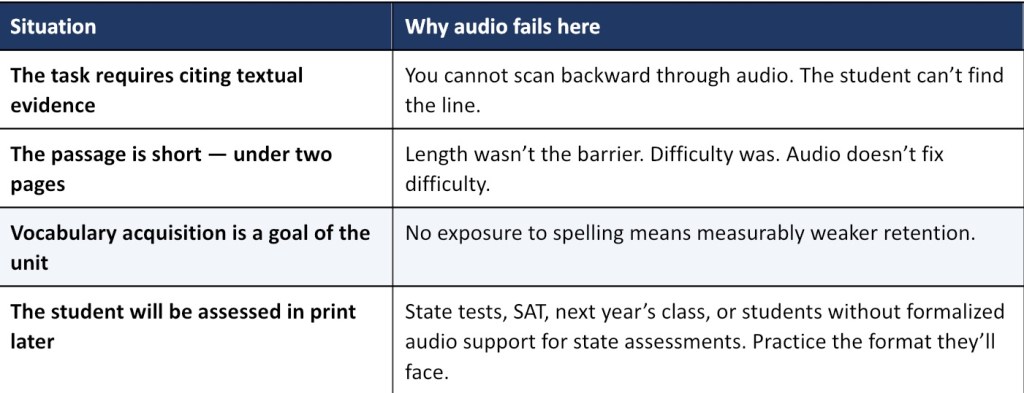
See It: Case Study – 8th Grade ELA
Here’s how this actually played out in one of my classes: 30 students, six with IEPs. Every one of those six IEPs listed audio or text-to-speech as a reading accommodation. On paper, that made the six of them look like one group. In the room, they weren’t. Five had documented decoding gaps that ranged from a 3rd-grade to a 6th-grade instructional level, and the sixth had a classic dyslexic profile — listening comprehension well above her decoding. Same accommodation, six different starting points.
In September I pulled fall benchmark data — oral reading fluency and, where I had it, a reading inventory — and used it to sort the six kids by profile and need rather than by the accommodations list on their IEPs:
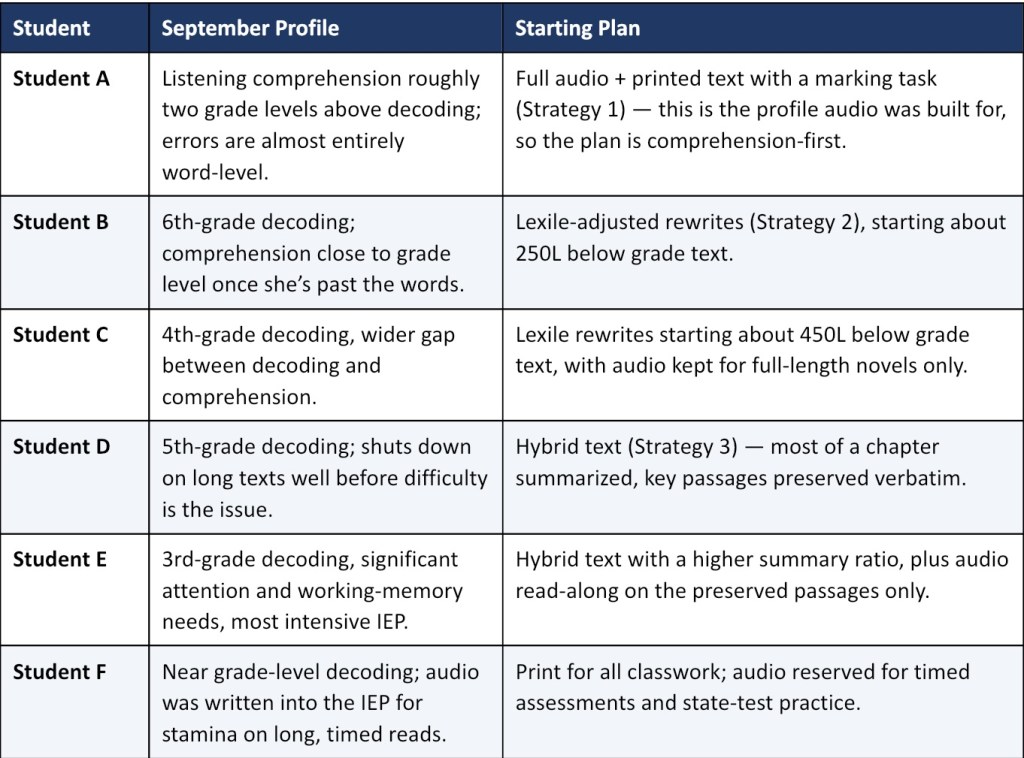
None of this needed a new curriculum or a separate lesson plan. Students A and F worked from the same text as the rest of the class the whole year. Students B and C read AI-leveled versions of it, built with the five-rule prompt above and double-checked against the change log. Students D and E read a hybrid version — one page of “read this part closely” boxes with the summaries surrounding key excerpts.
“The IEP says audio” turned out to be a starting point for a conversation, not the end of one — and the conversation looked different for every single kid in that room.
Tips and Resources
None of the strategies above require new software or a grant. Here’s what actually makes them sustainable on a normal teaching schedule.
AI Tools Worth Trying
- MagicSchool AI — its text-leveler/rewriting tool will take a passage down to a target Lexile or grade band in about the time it takes to paste it in. Still run it through the five-rule prompt from Strategy 2 — the default output has the same connective-stripping problem as any other tool.
- Diffit — built specifically to generate the same passage at several reading levels at once, plus vocabulary support and comprehension questions, which saves the step of writing your own questions for each version.
- A general chatbot (Claude, ChatGPT, etc.) — useful for the transcript cleanup mentioned above (stripping timestamps from a YouTube transcript) and for generating the Rule #5 change log as a clean, sortable list.
Graphic Organizers and Templates
- Marked-text tracker — a simple four-row form matching the Strategy 1 tasks: words circled, paragraph starred, evidence marked, and where the student got lost. Handing it out as a half-sheet turns “eyes on the page” into something you can actually collect.
- Hybrid text template — a reusable page layout with a bordered “Read this part closely” box for preserved passages and plain text underneath for your summary — build it once per unit and reuse the shell all year.
- Fade log — a week-by-week table with columns for student, strategy, current level (Lexile band or summary ratio), and comprehension check result. This is the artifact that turns “I think they’re ready” into something you can show a case manager.
A Few Practical Tips
- Sort by profile, not by accommodation. Two students can have the identical audio accommodation written into their IEPs and need completely different plans. Start the year by figuring out the trending gaps, or students with similar needs so that you can maximize your efforts when creating materials.
- Bring the fade plan to the IEP table. A documented plan to reduce a support as skills grow reads, to a case manager or a due process hearing officer, as thoughtful implementation of least restrictive environment — an accommodation with no plan at all reads as the opposite. Also, this is great information on student progress, and great data to include in annual reviews.
- Keep parents in the loop. The closed-captioning tip from Strategy 1 is the easiest lever most families have at home, and it costs them nothing to start tonight.
What’s your default when a student can’t access the text? Tell me in the comments — I read all of them!


Leave a Reply